Where's the point?
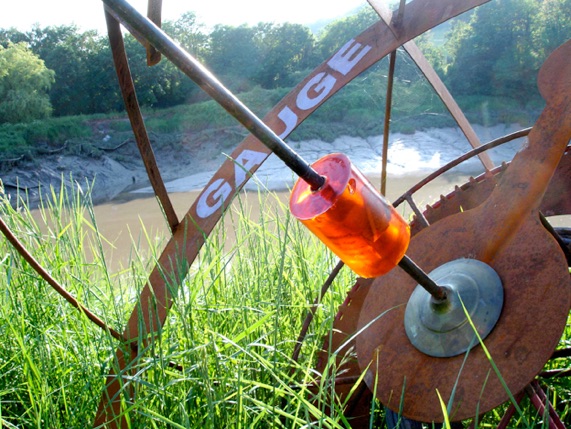
Western Tip, Spike Island, Bristol
"Meaning accrues over time; like respect, it is earned, not granted. While the designer yearns to establish a landscape that will acquire significance, it is not possible to use pat symbols alone as a means to transmute syntax into semantics, that is, tectonics into meanings… differences in culture, in education, in life experience, in our experience of nature will all modify our perception of the work… We cannot make that place mean, but we can, I hope, instigate reactions to the place that fall within the desired confines of happiness, gloom, joy, contemplation, or delight." Mark Trieb 'Must Landscapes Mean'
Time and Tide
How does the essence of a place change over the course of a day, through the seasons, the tide cycles and across the centuries?
In 2006, two of NOVA's time/tide pieces (by Lyons and Steel) were sited at the western tip of Spike Island, Bristol (a point currently nameless), and at the other side of the old lock entrance. These are a pair of of sentinel works, marking both sides of the old main entrance to Bristol's Floating Harbour. All of the many themes explored as part of 'Eleven Minutes' are woven into the fabric these pieces. Their position helps reveal the huge tidal range of the River Avon in Bristol. The inevitable slow disintegration echoes the transition of this city-zone from industrial centre to a peripheral - perhaps forsaken - space.
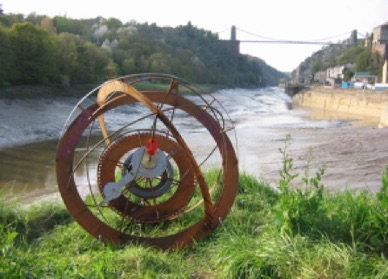
photo: owain jones, 2010
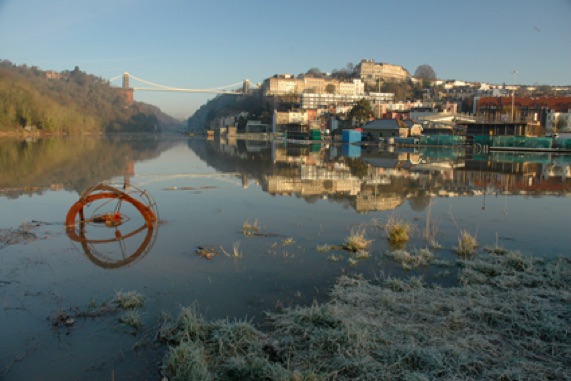
Western Tip, Spike Island, Bristol
In 2004/5, NOVA Creative Lab artist/designer Antony Lyons developed proposals for an eco-sensitive belvedere or 'look-out' point at this location - as part of a larger scheme called 'Avon Nexus'. This was selected as one of the winners in the visionary '200 Ideas for Bristol' in 2006.
Illustrations posted here soon.
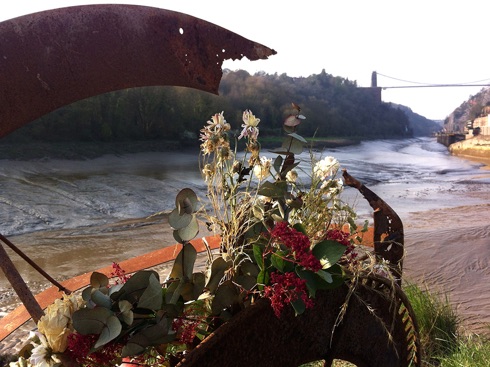
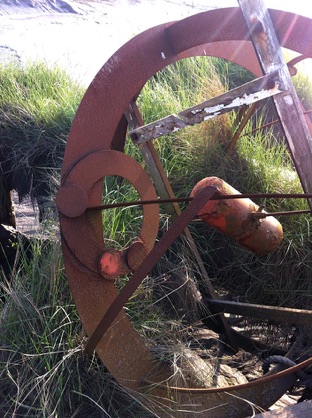
Western Tip, Spike Island, 2012
Slow disintegration.
Over the years, one of these sentinel pieces has become a site for tied-on flowers and messages. In its evolution, it was always a memorial, and now, even more so.
A 'wishing tree' or 'clootie tree' for a post-industrial place, and era ?